The Hengill region became blanketed in snow much earlier this year than last. The snow has greatly limited our access to our sites. We've tried walking (3 hours one way), skiing (2 hours one way), and earlier we described what happened the last time we used a truck. On Friday, the University of Iceland's Geology department allowed us to rent a couple of snowmobiles and borrow Sveinbjörn, a technician who helped out with the equipment and our reconstruction of our heat exchanger. We were able to get to our sites in 20 minutes on the snow mobiles (pics 1, 2, & 3).


The dam feeding water from stream 7 into the heat exchanger was breached in late November. Before we could return and fix the system the water left in the pipes froze. The heat exchanger was fine.
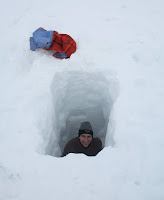
Friday, we traveled in by snow mobile, rebuilt the dam, and excavated three different sections of iced up pipe. One section of pipe was covered in a meter of snow in places (pic 6). After excavating the pipes we let them thaw in stream 8 (20˚C) and then reattached all the piping (pics 4 & 5). Everything was running smoothly when we left Friday evening.
After we finished up with the heat exchanger we went over to our reference stream to retrieve some dissolved oxygen probes before the holiday break. Normally this is a 45 minute drive in the summer, but it only takes 20 minutes on snow mobiles. I know what I was for Christmas. About 70% of OH2 was covered in a layer of hard packed, wind blown snow (1 to 3 meters worth). Here is Jim trying to pull a probe out of the lower section of OH2. There's really a stream down there. I swear.